Air Conditioners in Uzbekistan: Buy in April — Save Up to 28%
Home appliances: 221 тыс сум — compare prices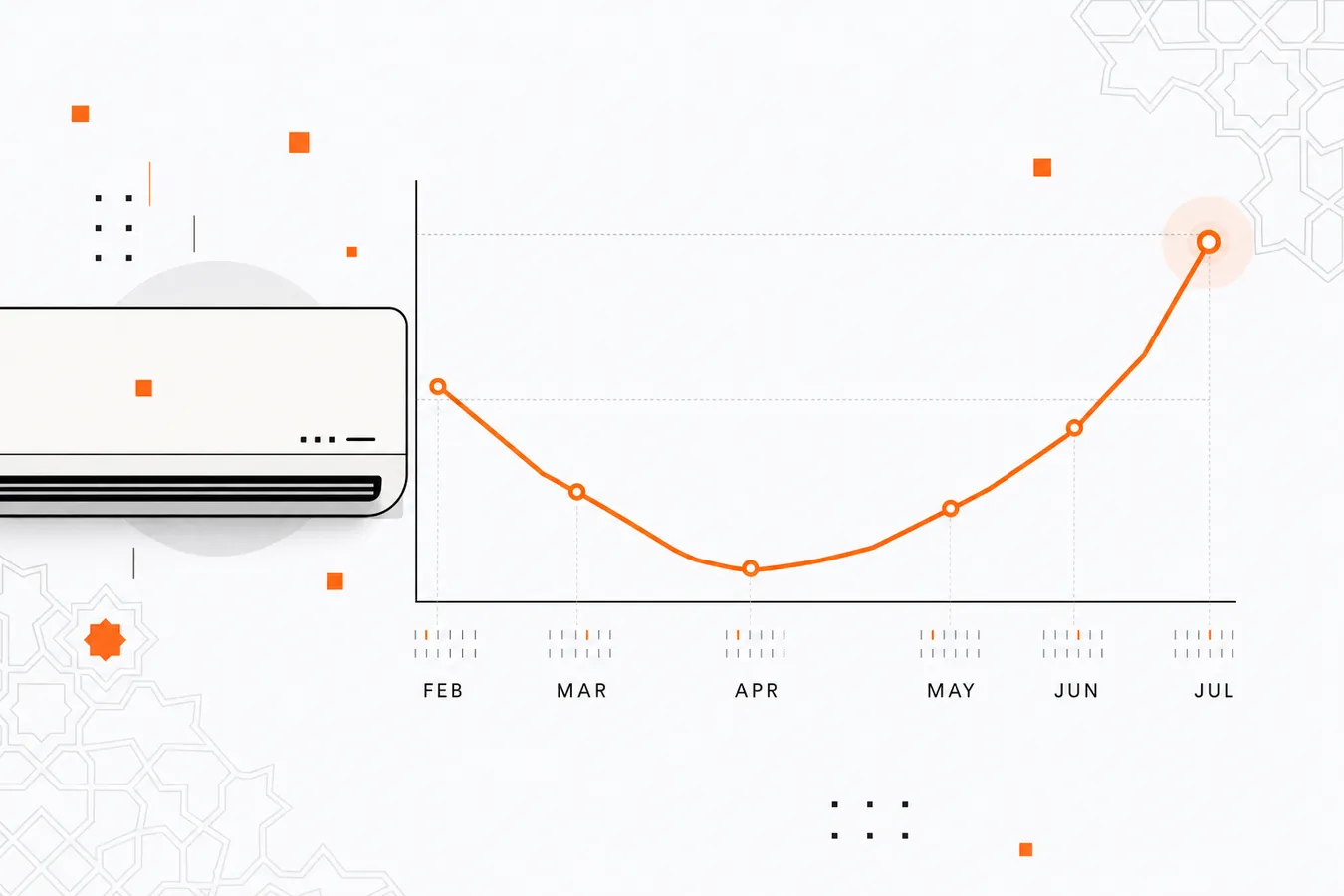
Products and prices for this topic
View the full category →



Last July, my old air conditioner died on the exact day it hit +41 in Tashkent. I opened my laptop, typed "Gree Lomo 12k" into five marketplaces in a row, and realized I'd walked right into the season when the buyer is left no choice. The price that had been 4.2 million UZS back in April was now sitting at 5.1 million. On top of that, every store slapped on a "summer sale −10%," which brought it to 4.6 million — still more expensive than the April price. I paid. The installer showed up four days later, charged 580 thousand for a standard installation, and said honestly: "Boss, in April it would've been 350."
This article is an attempt not to repeat my mistake in 2026. From April through July 2025, we recorded daily prices for three popular air conditioner models across the five largest Uzbek marketplaces. Below is what we found, and what to do about it for a family whose AC hasn't died just yet.
What we looked at
A basket of three models that sell steadily in UZ and are available on all five platforms: Gree Lomo 12k BTU, LG Dual Inverter 12k BTU, Samsung WindFree 12k BTU. The platforms — Uzum, Olcha, Asaxiy, Texnomart, Mediapark. Price collection — daily from April 1 to July 31, 2025, 122 data points for each SKU in each store. We took only the published price from the product page, excluding loyalty points and "−5% with card" bonuses — because those are add-ons that require a separate action and not everyone has them.
What follows are three pictures across three models. The figures are rounded to the nearest ten thousand to keep the article readable.
The numbers: April vs July
Gree Lomo 12k BTU. In April, the minimum basket price across the five stores held at around 4.2–4.3 million UZS. By the end of June, the same model was already 4.9 million. The peak came in the third week of July — 5.3–5.4 million UZS depending on the store. The increase from the April minimum is +26–28%. In parallel, three stores stuck a "summer sale −10%" label on the product, which worked out to exactly 4.8 million. In other words, the "discounted" July price was 14% more expensive than the honest April one.
LG Dual Inverter 12k BTU. The starting April price was 6.1 million UZS at the cheapest of the five. In May it rose to 6.4 million, in June to 6.9 million, with the July peak at 7.2–7.3 million UZS. The increase is +18–20%. The spread on LG is smaller: the brand enforces stricter recommended prices, and stores can't push them up as freely as with Gree. But the "summer sale −15%" that appeared on July 5 was calculated from a fabricated "old price" of 8.5 million, which didn't exist on a single day across all 122 of our observations. This is exactly the case banned by the October 2025 Cabinet of Ministers resolution.
Samsung WindFree 12k BTU. The most expensive model in the basket and the most "honest" in terms of seasonal volatility. April — 8.8 million UZS, July — 10.4–10.6 million UZS. The increase is +18–20%. There were almost no sales on Samsung over the summer: stores already sell the model at the ceiling, so there's no reason to discount. Paradoxically, this is a more transparent picture for the buyer — there's no illusion of "savings," just the season.
Summary across the three SKUs: the April minimum versus the July maximum is an 18–28% difference on the same model in the same store. No change in specifications. Just the season.
One more observation — the holiday "sales" (Navruz, Ramazan Hayit) turned out to be fake in most cases in our sample. The price went up 1.5–2 weeks before the date, and on the day of the "sale" returned to the fabricated "old" price. This is a pattern common across the whole region, but the Uzbek buyer notices it last — because until recently, the tool to check the 30-day history was available only to the stores themselves.
Why July is the peak
The seasonal dynamics for air conditioners in Uzbekistan are arithmetically structured. Demand concentrates in the May–July window, and in Tashkent roughly 70% of annual sales fall within about 60 days. A salary cycle works in parallel: most of the population gets paid in the second half of the month, and stores have long since synced their "sales" to those windows — hence the waves in mid-June and mid-July.
Supply doesn't help the buyer either. Containers of Chinese air conditioners are planned 3–4 months ahead. If a store under-ordered in April, it certainly won't restock in July — it will simply raise the price on the remaining stock to a level the market will swallow. And at +41, the market will swallow almost anything.
A strategy for the family
The dumbest and most effective rule: buy your air conditioner in April or early May, before the first heat drives the neighbors into the stores. On our data, that's a saving of 18–28% on the unit itself and another 30–40% on installation (more on that below).
If the April window is missed and it's already mid-July — don't buy on a "summer sale." Wait until the end of August: stores traditionally clear out warehouse stock before the winter season, and prices roll back to May levels. On two of the three SKUs in our sample, the August dip was deeper than June's.
The third rule — check the "sale" against the 30-day window. Since October 21, 2025, the "old price" from which a discount is calculated is legally required to equal the minimum price of that product over the past 30 days. If a store draws "was 8.5 million" in July, but in June the model never cost more than 7 million on any day — the old price is fabricated, and there's no real sale. That's a ready-made complaint to the Antimonopoly Committee.
Installation is getting pricier too
This is the part of the budget people forget when comparing prices on websites. Standard installation of a 12k BTU air conditioner (no complex routing, up to 3 meters) in the off-season is usually 250–450 thousand UZS depending on the district and the company. At the July peak, the same crew charges 350–650 thousand UZS, and you often can't book sooner than 5–7 days out. That's my experience from last summer — and four installers I spoke to afterward confirmed this range.
The reason is the same — demand. There's a finite number of crews in Tashkent, and in July 30 people call every day. Installers start turning away anyone unwilling to pay the peak rate. So the real saving from buying in April is not just the unit price, but the unit + installation total, and on the Gree basket that comes out to a 1.2–1.5 million UZS difference between April and July. On Samsung — 1.8–2.2 million.
A separate observation: if you buy the unit in April but are ready to install in May — half the installers will agree to the May price with a prepaid April measurement visit. That's a negotiable thing, not a rule.
One more nuance — the warranty. A unit bought in July in the "discount" category often gets a reduced warranty: the store states 12 months instead of the required 24. The explanation is "it's a sale item." The real reason is that the store wants to turn over its stock faster and prices the failure risk into its margin. Before clicking "buy," read the receipt and the certificate — that will save you not the price of the unit, but the price of a repair in its second year.
And the electricity bill. The inverter LG and WindFree-Samsung consume roughly 25–30% less than the non-inverter Gree at the same cooling capacity. Over 30 days of July at Tashkent tariffs, that's an 80–120 thousand UZS difference. Over one season the sum is modest, but the unit lives 7–8 years, and over that span it adds up to 5–7 million. A 1.5 million difference in the starting price pays for itself in exactly two seasons.
What to do right now
If you're reading this in April — you have the perfect window. Take three models from your category, check them across five stores, pick the minimum, and arrange a May date with an installer. You'll save 20–30% on the unit + installation basket.
If you're reading this in July and your AC has died — buy from someone who holds an honest price without fabricated "sales," and don't trust a "−15%" off an invented old price. Through the 30-day check, 70% of summer "sales" turn out to be fiction.
BirBozor records the prices of these SKUs across all five stores every day and shows a 30-day chart on the product card. The beta is still 8 weeks from launch, but on the Telegram channel @birbozor_uz we post daily manual checks — including for seasonal goods. Subscribe if you want to catch the April 2026 window ahead of time, rather than on the day your old unit dies.
Save a product in farq.uz — we show the 90-day low next to the current price tag.
Subscribe @farq_uz